Join me on a journey through the world of car design, where we’ll uncover how windshield pillars and the glass house shape our driving experience, blending safety with beauty.
 Written by Nino Kojadinovic

Have you ever heard about the term “glass house” in the context of automotive design? The glass house refers to all the glass elements of a car’s design, encompassing the windshield, back window, side windows, and sometimes the sunroof, if there is one.
This term highlights the parts of the vehicle made of glass and is a crucial aspect of a car’s design for several reasons, including visibility, aesthetics, and structural integrity.
Transitioning from the glass house, an equally vital aspect of automotive design that deserves our attention is the structure known as car pillars.
Car pillars, often overlooked components of a vehicle’s structure, play a pivotal role in your car’s safety and aesthetic appeal.
The A, B, C, and potentially D pillars are the vertical supports of a car’s glass house, framing the windshield, doors, side windows, and back window.
These pillars play a crucial role in the car’s overall structure and safety, especially in the event of a rollover accident, where they help maintain the integrity of the cabin space.
Integrating these pillars with the glass house components is a delicate balance between form and function. Designers aim to maximize visibility and light inside the cabin, enhancing the driving experience and safety while ensuring the vehicle’s structural integrity, aerodynamics, and efficiency.
Frame the front windshield and stretch from the car’s hood up to the roof. They are critical for supporting the roof and play a significant role in front visibility. Designers work to make A-pillars as slim as possible to minimize blind spots yet strong enough to support the vehicle’s structure.
In designs where the glass house emphasizes openness and visibility, B-pillars may be minimized or hidden, which presents challenges in maintaining structural integrity and safety. These pillars provide structural support and are integral to the safety framework, especially for side-impact protection.
Situated at the rear of the vehicle, framing the sides of the back window. The design of the C-pillar affects rear visibility and the vehicle’s aerodynamics. In some designs, especially in hatchbacks and SUVs, the C-pillar can be quite broad, which may impact rearward visibility but provides structural support and can contribute to a distinctive silhouette.
These pillars support the back of the roof and influence the design and aerodynamics of the vehicle.
Found in larger vehicles like SUVs or Station Wagons, D-pillars are the last vertical supports at the rear, framing the backside windows or the back window. They play a role in the overall stability and safety of these larger vehicles, contributing to the rigidity of the rear part of the vehicle.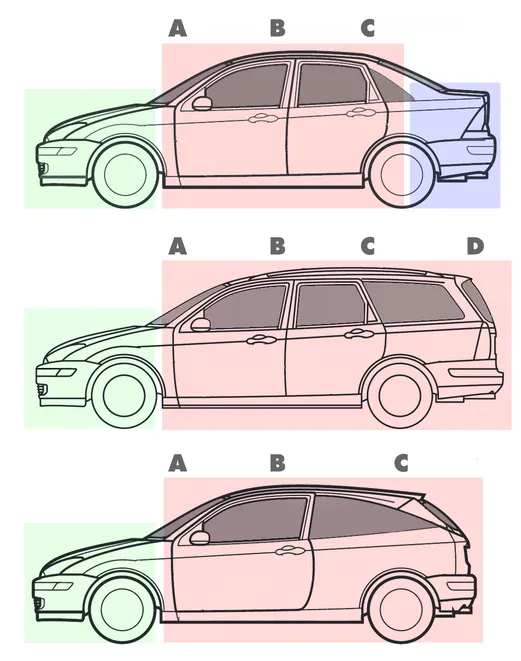
Manufacturers use a combination of high-strength steel and aluminum materials to construct windshield pillars, balancing strength, weight, and cost. The design and thickness of these pillars have evolved, with modern vehicles often featuring thinner pillars for improved visibility without compromising safety.
Regular inspection of windshield pillars is essential to identify signs of rust or damage early on.
A stone chip is not limited to the windshield; your pillars are exposed to the same risks. Any compromise to their integrity can significantly impact the vehicle’s safety performance.
Common issues with windshield pillars include corrosion, particularly in older vehicles or those frequently exposed to harsh weather conditions.
Solutions involve prompt rust treatment, or in severe cases, a thorough inspection is necessary to assess structural damage.
When left untreated, corrosion spreads to areas covered by the windshield, making it hard to spot from the outside. For these reasons, a technician’s warranty usually doesn’t cover a replacement when a significant amount of rust is present in the windshield frame.
The best way to address this issue is to have your replacement carried out in two phases.
First, have the windshield removed, then get a car body specialist to remove the corrosion, followed by an expert auto glass technician who will return to install the new glass.
This approach will make the replacement more costly, but it extends the longevity of your car and helps avoid leaks down the road.

Looking for a windshield replacement quote for your Toyota Camry? Technicians in our network work on ADAS-equipped cars, and you get a price before any work starts.

Seeking a solution to prevent prying eyes from peeking into your car? Understanding privacy glass in a car is essential for you!

When driving in the fall, it’s important to be aware of the leaves and tree sap that fall from the trees. Not only are they crunchy and slippery underfoot, but they can also be a major nuisance when they get on your windshield.